
Travel insights from Latin America
Study Abroad Applications: Why Students Start but Never Finish Them
Author Juan Felipe Jimenez | Published on September 24, 2026
Ever wondered what happens when you see a student genuinely excited about studying abroad, but then the study abroad application never appears?
This is a common observation from university faculty and can be a huge source of frustation for study abrorad offices wanting to push their international programs.
In this blog, we will explore why students often abandon their study abroad applications, what you can do as faculty to encourage students to complete the process, and how travel operating partners can increase student uptake.
Why Do Students Abandon Study Abroad Applications?
The problem is not always a lack of interest.
More often, uncertainty builds along the way: How much will it really cost? Will the courses count toward my degree? What happens if I need support while abroad?
At first, these may feel like small questions. But when several remain unanswered, the study abroad application process can start to feel more complicated and risky than the opportunity itself.
A student may be excited when they first discover an international experinece on the horizon, but completing an application requires sustained clarity, confidence, and support across multiple decisions.
Universities should explore why this drop-off is happening. A student who stops halfway through the process is not necessarily “demotivated.” Their experience could very well reveal friction in the process that the institution can identify and improve.
There is rarely one single reason. A student may discover unexpected costs while simultaneously trying to understand academic approvals, gather documentation including insurance and permission slips, and meet an application deadline.
Each issue adds a little more uncertainty until completing the application no longer feels straightforward.
These barriers can also overlap. For example, unclear costs may delay a conversation with an adviser, which could then result in a missed deadline. What looks like a personal decision to abandon the program may actually be the result of several connected obstacles.
Universties should distinguish between the process issues they can change and personal circumstances they can only accommodate or support. Making the process clearer cannot remove every barrier… but it can prevent unnecessary ones.
The Full Cost Becomes Clear Too Late
This is a common complaint – the fact that the advertised program fee is rarely the whole financial picture. Let’s face it, no-one likes unexpected costs!
Students may also need to account for flights, deposits, insurance, visas, meals, local transportation, and personal spending. Funding can add another layer of uncertainty, particularly when students are trying to understand eligibility, deadlines, and whether financial support is guaranteed.
For students researching study abroad scholarships for college students, timing matters too. Knowing that funding may exist is very different from knowing when to apply, whether they qualify, and when they can expect a decision.
Universities may not be able to make a program cheaper, but they can make the financial picture easier to understand. Providing a complete cost and payment timeline early can reduce uncertainty before students invest significant time in their application.
The Process Is Longer or More Complex Than Expected
A study abroad application is rarely run by one person or connected to one system.
Students may move between program selection, academic approval, advising, passports, recommendations, health forms, and funding. Different logins, unfamiliar terminology, duplicate questions, or requests for information they do not yet have can quickly create friction.
The opportunity is to make the sequence visible: what happens first, what depends on something else, what needs to be submitted, and who can help when a student gets stuck.
Students Fail to See How the Program Fits Their Degree
“Earn credit abroad” sounds reassuring, but it may not answer the question students actually have: Will this program be useful for my degree?
Students may need clarity around credit amounts, course equivalencies, prerequisites, assessment, major or general-education requirements, and whether participation could affect their graduation timeline.
Specific examples and clear approval routes can make this easier to understand than generic promises. Coordination between study abroad teams and academic advisers is equally important so students are not receiving different answers from different parts of the university.
Confidence and Belonging Drop During the Process
Students may worry about what it will be like to travel alone, join an unfamiliar group, navigate a different language or food culture, be away from family, or manage an unexpected situation abroad.
A program can look exciting while still making students feel anxious about the unknown. Realistic information can help calm these nerves. Conversations with returned students, introductions to the cohort, and honest discussions about both challenges and benefits can make the experience feel more tangible and more achievable.
Accessibility and health Questions Remain Unanswered
Students may also need answers about mobility, sensory access, chronic conditions, medication, dietary requirements, mental health, neurodiversity, or stamina.
General statements about accessibility are less useful than practical information. Details about terrain, stairs, transportation, accommodation, bathrooms, downtime, climate, and access to medical care can help students understand whether a program is feasible for them.
These conversations should also have a confidential pathway. Addressing needs early gives study abroad teams an opportunity to coordinate with accessibility or health teams before the student has to make a final commitment.
Mixed and Confused Communication
Portals, emails, faculty members, advisers, and external providers can all become part of the same application process.
That can create another kind of uncertainty when students receive incomplete or conflicting information, or simply do not know which message to follow.
A clearer approach is to communicate around milestones: what has been completed, what comes next, when it is due, and who can solve a problem.
One reliable source of information, supported by human follow-up at high-friction stages such as deposits, passport deadlines, and funding decisions, can make the journey much easier to navigate.
How Can Universities Improve Application Completion?
Improving completion does not necessarily mean removing every requirement.
Instead, universities can map the journey from initial interest to commitment, including handoffs between study abroad, academic advising, financial aid, and accessibility teams.
They can also provide key information before students invest heavily in applying: costs, eligibility, dates, credit, accessibility details, and the main approval stages.
Breaking the process into smaller milestones can make the next action easier to understand. Targeted support from advisers and peers can then address the questions that matter most at each decision point.
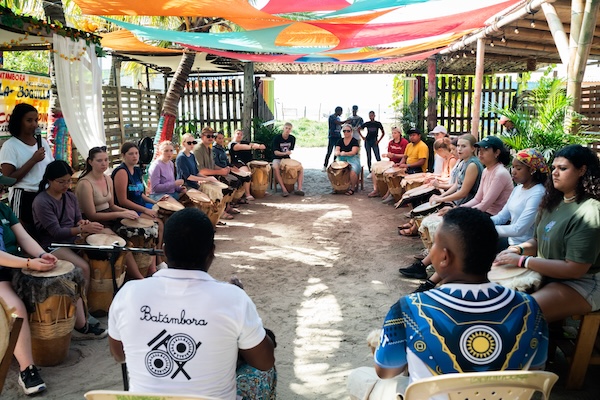
Nazareth University students on a study abroad program in Cartagena
Kagumu tips for encouraging students to complete the study abroad application process:
- Empower student leaders – identify the most outgoing, organized and passionate students and empower them to act as student leaders for the group. This means getting them to organize their peers and act as the bridge between faculty and student groups. Incentivize students by offering a stipend, free gifts, discounted trips or even a faculty reference for their resume. Read here, one student leader’s experience helping to promote a study abroad program for Nazareth University.
- Over estimate the costs – if you are in doubt of the true cost of a study abroad program, overestimate slightly so the surprise is not an unpleasant one.
- Follow up and follow up – students are incredibly busy with studies and their own private lives and might need a nudge. Follow up emails are generally welcomed by all students.
- Commit to the cause – really push study abroad and the benefits by going big on promotion, study abroad fairs, social media takeovers, and talks from alumni – ensure excitement is rife among students.
- Work with a local operator – working with a partners in the destination of your study abroad program will give you a huge boost and can help with detailed information about the international experience and many can offer promotion help.
What Should Study Abroad Teams Measure?
Universities cannot improve application drop-off if they do not know where it happens.
A useful funnel can track the journey from initial interest and application starts through major stages, submission, acceptance, and final commitment.
Teams can also look at the time between stages, repeated questions, missed deadlines, withdrawals, and voluntarily shared reasons for stopping.
Segmenting this information -and speaking directly with students – can reveal whether particular groups experience more friction at specific stages. The goal is not simply to measure who drops out, but to understand why.
How Kagumu Adventures Can Reduce Planning Uncertainty
For a university working with an external study abroad provider, asking them to provide detailed program information in advance can answer many practical questions before they become barriers.
Kagumu Adventures can provide verified information about inclusions, itineraries, accommodation, transportation, daily demands, and support arrangements. This gives university teams clearer information to work with when discussing program fit with students.
The goal is to make the destination and logistics easier to understand, so students can feel empowered to make those decisions with greater clarity and confidence.
A well-planned study abroad program should involve more than an exciting destination. It should give students enough information to understand what they are choosing and give universities the tools to help them get there.


