
Travel insights from Latin America
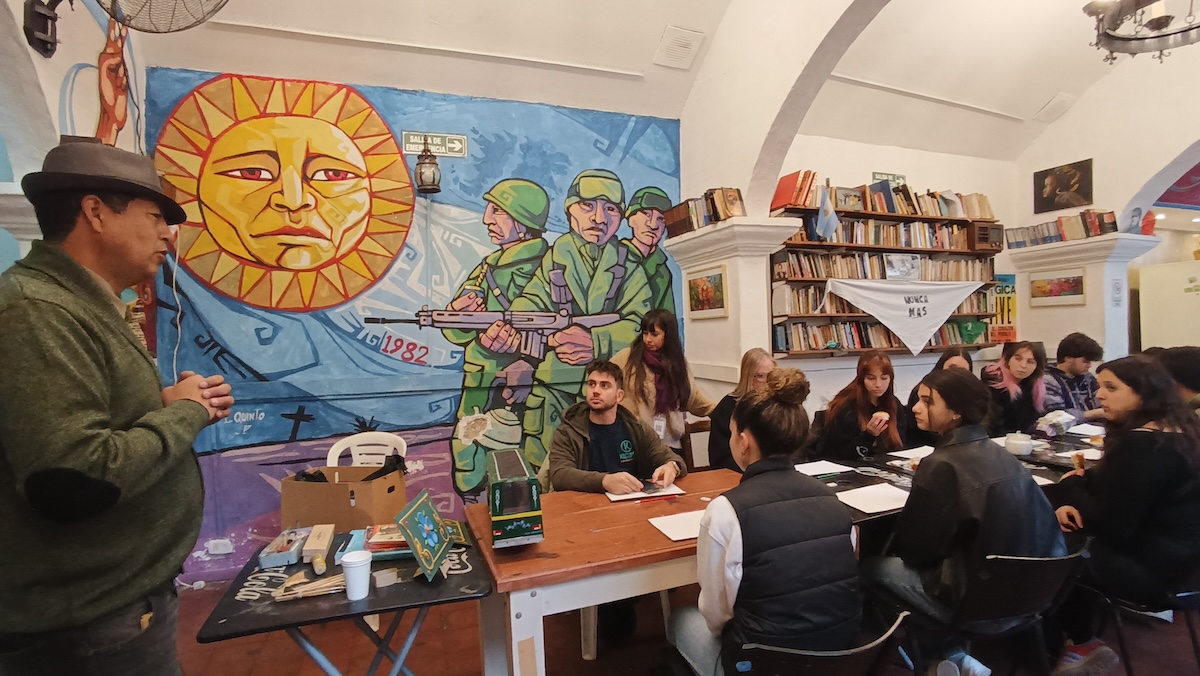
Author Juan Felipe Jimenez | Published on November 18, 2026
In Argentina, politics, history, and culture are rarely separate subjects. They intersect in government institutions, public squares, museums, neighborhoods, and conversations about the country’s past and present.
Consider the questions students might explore in Buenos Aires, for example. How does political participation shape public life? Who determines how a country remembers a dictatorship? How do migration and social movements influence national identity here? These are all meaty topics that could spark fascinating debates.
Córdoba offers a different but equally valuable perspective. Home to the National University of Córdoba, the city was the birthplace of the 1918 University Reform Movement, in which students challenged traditional university structures and demanded greater autonomy, academic freedom, and participation in university governance. Its influence extended across Latin America, making Córdoba a relevant setting for examining student activism, education policy, and the relationship between universities and society.
This is what makes Argentina a compelling destination for a faculty-led study abroad program. Faculty can use its institutions, cultural life, and sites of memory as material for academic inquiry.
In this blog, we outline a few of the ways these topics could be explored in the contexts of Buenos Aires and Córdoba.
Study Politics Where Public Spaces Become Political Symbols
Political systems are easier to understand when students can examine both their formal structures and the ways people engage with them.
Buenos Aires offers a useful setting for exploring this relationship. As Argentina’s capital, it brings national political institutions and visible forms of civic participation into the same urban environment.
A visit to Argentina’s National Congress offers a particularly relevant example when examining the country’s 2001 political and economic crisis. Following widespread protests in December, President Fernando de la Rúa resigned, and Congress subsequently selected Eduardo Duhalde as his successor in January 2002.
Meanwhile, Plaza de Mayo became a focal point of demonstrations demanding political change. These events allow students to examine how institutional decisions and public pressure intersect during a period of political instability.
Its significance invites students to consider how public spaces become political symbols, how citizens make their concerns visible, and why particular locations acquire meaning over time.
The value lies in comparing these settings, not simply visiting them.
Faculty might ask students to identify the different forms of participation they observe or research, then discuss how public demonstrations interact with representative institutions. Students could compare their findings with political theories studied before arrival.
These questions are relevant to International Relations and comparative politics, but they can also support sociology courses examining collective action, social institutions, and the relationship between individuals and the state.
Explore the Depiction of Dictatorship and Democracy
Argentina’s last military dictatorship, which began in 1976 and ended with the restoration of democracy in 1983, is an important subject for students examining authoritarianism, state violence, and democratic transitions.
A carefully prepared visit to the ESMA Museum and Site of Memory can support this work. The museum occupies a former clandestine detention, torture, and extermination center used during the dictatorship.
Its permanent exhibition draws on historical documents and victims’ testimonies to examine crimes committed there. The site is also recognized on UNESCO’s World Heritage List.
For students, this creates an opportunity to consider how historical evidence is preserved and presented, how testimony contributes to the historical record, and what responsibilities institutions have when documenting human rights violations.
Before visiting, faculty can introduce the historical context, establish respectful discussion guidelines, and explain the purpose of the experience.
Afterwards, a facilitated reflection can help students connect their observations with academic readings and consider how different forms of evidence contribute to historical understanding.
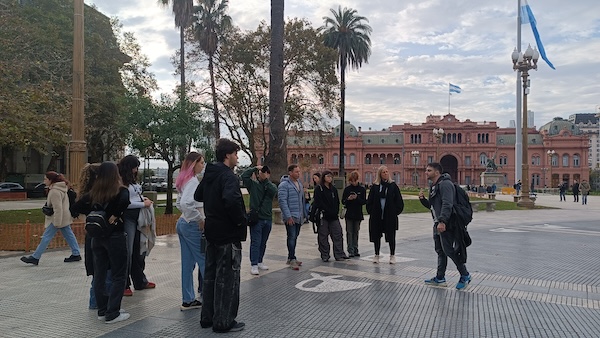
Kagumu student visitors on a walking tour to Casa Rosada in Buenos Aires, Argentina.
Connect Social Movements With Public Space
Argentina’s history of human rights advocacy provides another way to examine how collective action can shape public debate.
The Mothers and Grandmothers of Plaza de Mayo are central examples. These organizations emerged in response to the forced disappearances of people during the dictatorship and have played important roles in demanding truth, justice, and answers about missing relatives.
Plaza de Mayo can help students consider these questions through the relationship between a physical location and a wider political movement. The square is not significant simply because demonstrations have taken place there. Its meaning has developed through repeated acts of public presence, remembrance, and demands for accountability.
Faculty could build a focused learning activity around three sources: observations from a visit to the square, a primary source from a human rights organization, and an academic reading on social movements or transitional justice.
Students could then compare how each source communicates its message, what evidence it provides, and which perspectives it emphasizes.
This approach also encourages students to distinguish between witnessing a place and understanding its history. A visit provides context, but historical documents, scholarly interpretation, and the voices of those involved are necessary to develop a fuller picture.
Read Migration and National Identity Through Living Culture
National identity evolves through migration, language, and cultural exchange. Argentina offers a useful context for exploring how these influences shape culture and belonging.
Tango is one example. UNESCO describes it as a tradition that emerged in working-class communities in Buenos Aires and Montevideo, shaped by European immigrants, descendants of enslaved Africans, and criollo communities. Its history illustrates how different cultural influences can shape a shared tradition. UNESCO’s overview of tango offers a starting point for examining these connections.
Faculty can use tango, along with the urban culture of neighborhoods such as San Telmo and La Boca, to explore how migration, class, race, and gender influence cultural identity. These examples also help students question how traditions become symbols of national identity without representing everyone’s experience.
For language learners, cultural activities and everyday conversations provide opportunities to practice Spanish skills in context, connecting classroom learning with life beyond it.
Turn Visits Into Structured Academic Work
Field experiences become more valuable when students know what they are investigating and have time to make sense of what they encounter.
Faculty do not need to turn every activity into a formal assignment. A simple structure can help connect experiences with course material while leaving room for curiosity and discussion.
Set a question before each visit.
Before visiting Plaza de Mayo, ask students: How have protests and public demonstrations in this square influenced Argentina’s political history?
Gather evidence on site.
Ask students to record observations, identify relevant displays or documents, and note questions that arise. Encourage them to distinguish what they directly observe from what they already know or infer.
Connect observations with academic sources.
After the visit, students can compare their notes with a primary source, assigned reading, or relevant theoretical framework. This helps them test their initial interpretations rather than treating a personal impression as a complete explanation.
Make time for reflection.
A short discussion, field journal, comparative assignment, or group presentation can help students identify what they learned and which questions remain unresolved.
Local expertise is essential throughout this process. Museum educators, researchers, community organizations, and other local specialists can provide context that visiting faculty may not have. Their participation should be arranged in advance, with clear expectations and respect for their time and knowledge; a particular speaker or meeting should never be assumed to be guaranteed.
For faculty planning a faculty-led study abroad program, this means starting with the learning outcomes and building the itinerary around them. Visits, local activities, and opportunities for discussion should work together rather than compete for students’ attention.
Final Thoughts
Argentina offers distinctive opportunities for students to examine politics, history, and culture in relation to one another. Its public institutions provide a setting for investigating political participation. Sites of memory support careful study of dictatorship, democracy, and human rights. Social movements and cultural traditions reveal how collective identity develops and changes.
For faculty, the value lies in bringing these elements together around defined academic questions. A well-designed program allows students to examine evidence, encounter perspectives beyond their usual academic environment, and reflect on how classroom concepts hold up in practice.
If you’re considering Argentina for an upcoming faculty-led program, Kagumu Adventures can help you explore how local experiences, academic objectives, and practical planning can work together. We can start with your course goals and discuss what a program designed around your students’ learning needs could look like.


