
Travel insights from Latin America
Comuna 13: after saying goodbye, we want to know if things have improved
Author Simon Willis | Published on November 16, 2026
In November of 2025, Kagumu decided to stop taking travelers to one of the most popular tourist destinations in Medellin, Colombia.
While to many it seemed like a strange business decision, we thought differently! And we remain firm in our decision. Visitor numbers to Comuna 13 continue to skyrocket, and the problems for residents do too.
Our decision, and the reasoning behind it, gained traction and led to wider publications on the issue; the research from which won multiple awards from the British Guild of Travel Writers for nuance, insight, and tackling complex and sensitive issues linked to tourism.
But one year on, has anything improved?
We reviewed the situation with our operations manager, Ana, an expert guide who has brought visitors to Comuna 13 for many years. She also grew up in the neighbourhood and has seen, firsthand, the evolution of Comuna 13. She has shared and listened to many stories from residents as the tourism industry continues to boom.
There’s no denying that Comuna 13’s story of transformation – from arguably one of the world’s most dangerous neighborhoods to one of the most vibrant and visited places in the country – is fascinating. And the movement to reclaim the neighborhood by local artists, activists, and change-makers is hopeful and uplifting.
Certainly, for the team at Kagumu Adventures, the concept of ‘community-led tourism’ is one of the most crucial components of all our itineraries. We don’t deny that Comuna 13, for many years, was an excellent example of this. And we know that the negative impacts of tourism are not limited to Comuna 13.
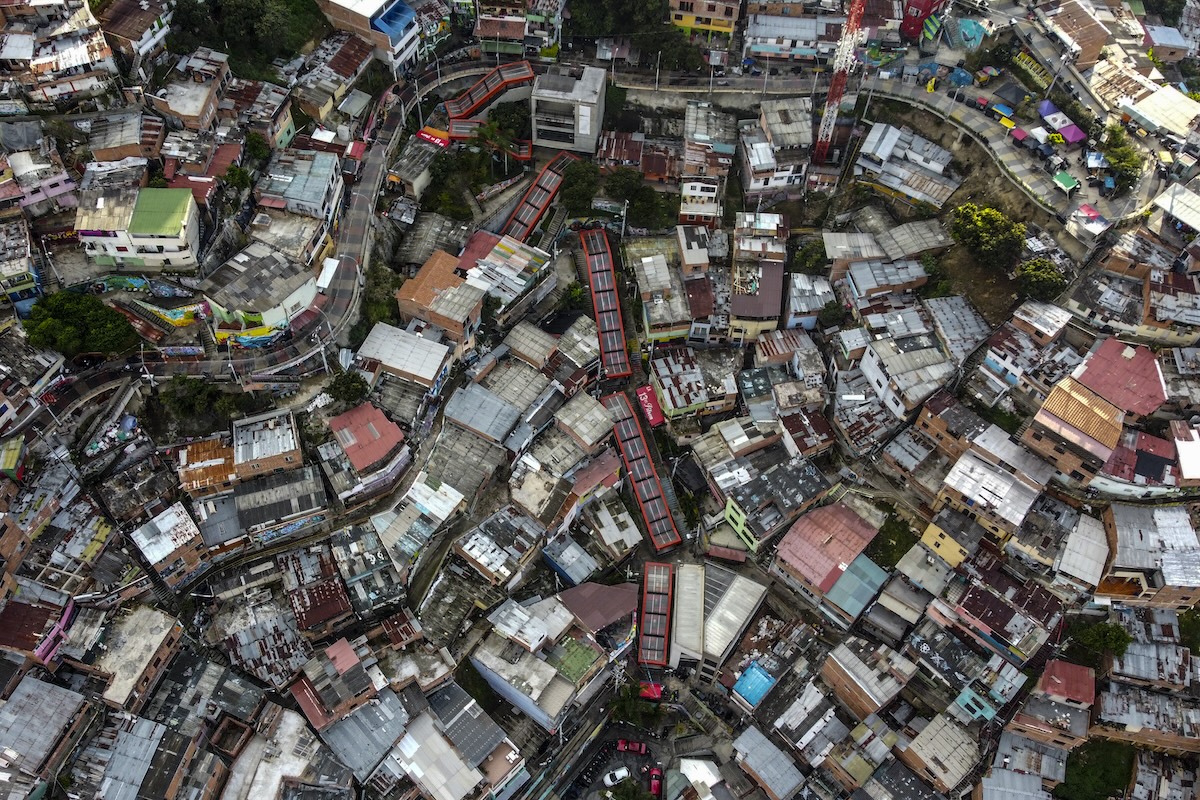
But estimated visitor numbers continue to grow, with the most recent figures suggesting between 17,000 and 30,000 people passing through the narrow streets and steep inclines every day during peak season.
And the problems remain: chaotic, unregulated development, difficult living conditions for many locals, potential dangers for those living and visiting the area, the erasure of a big part of local art and culture, and a new surge in gang dominance.
Last year Ana moved out of the neighbourhood due to the impact of the tourist industry on the neighbourhood, but returning for visits, she still has the same concerns:
“Even after moving out of Comuna 13, I continue to be very concerned about what happens in the most touristy part of the district. What I find particularly frustrating is that every time I go there with tourists, I see how the problems and consequences of excessive tourism, without boundaries, rules, limits, proper studies, or the use of technology to manage it, continue to grow, while no authority seems to be genuinely addressing them.
There is also a serious lack of control over construction and visitor capacity. Additional floors and terraces have continued to be built and expanded without permits, proper oversight, soil studies, or structural safety assessments.
For example, many of these terraces receive dozens or even hundreds of visitors every day without any proper assessment of their structural capacity.”
An article published in June 2026 in El Colombiano reported that 88% of the murals that depicted stories of community and resilience, and were the original draw to the neighbourhood for visitors, are now covered by makeshift stands and the unregulated construction that Ana refers to.
According to locals, it has “lost its essence,” with many visitors treating it more as a theme park than a neighbourhood where people live and work. And for some locals, the opportunity to make money has overtaken the desire for a harmonious and happy space for residents.
And the key issues that we identified last year remain:
Struggling infrastructure
The area around Comuna 13’s ‘electric stairs’, which were originally designed to mobilize around 12,000 people each month, was reportedly carrying this number in just one day!
Not only this, but the informal construction of the neighborhood with its narrow winding paths, rapid, unregulated building work and the increasingly erratic weather conditions have the potential to cause serious risk to both locals and visitors.
Restricted access
The sheer quantity of groups visiting on any given day means that the houses at the center of it all are no longer accessible by vehicle. Whilst for some this is, at best, inconvenient, for many others it has serious implications.
Angela, a local resident with three children with disabilities and an aging father, is unable to reach her front door by taxi. She explains in this video for Mañana Express how difficult life has become for her family and neighbors.
The overcrowding situation became so bad that the Municipality of Medellin put out alerts, warning of the lack of mobility around the neighborhood.
Sound pollution
Visitors may like the ‘hustle and bustle’, blaring music, and shouts from street performers as they search for a ‘lively’ atmosphere and a memorable experience.
But for those living there, the ability to work, relax, watch TV or sleep becomes more and more difficult.
“My sister-in-law had to finish her pregnancy elsewhere, because the noise here was stressing her out,” one resident was quoted as saying.
And the noise (and actual) pollution spreads much further, as taxis queue to drop off and collect tourists at the bottom of the hill.
Waste management issues
As restaurants and stalls have popped up everywhere to take advantage of visitors’ rumbling bellies and desire for a michelada (a refreshing drink made of beer, lemon and salt), the waste management systems are struggling to keep up.
‘And this mountain of rubbish in Comuna 13? A time bomb threatens the neighborhood’, is the title of an article written by Exclusivo Colombia.
The article highlights the ‘mountains of rotting waste’ and ‘feasts for rats and vultures’ that accumulate overnight.
This is a result of hordes of tourists generating more rubbish than both the authorities and residents are able to dispose of. In turn, this creates an unappealing and unhygienic environment for residents to live in.
Impact on the youth
Whilst the majority of tourists are well-meaning when they offer a few Colombian pesos to local children in exchange for a tour or a game of football, the knock-on effect can be hugely negative.
Older generations, like one of the residents in this same video for Mañana Express, have noticed their children and grandchildren using toys as a money-making tool rather than for play, and there have even been suggestions of turf wars between these young groups.
Lack of reinvestment
The overall wellbeing of residents was once a major original factor in opening up the community to visitors. But as of 2024, it slipped off the radar.
Reinvestment into community assets like playgrounds has been left to one side, and previous homes have been abandoned and turned into shop fronts and fronts for businesses.
Lack of equity
Although tourism may be offering local employment to some, the majority of people benefiting are outsiders.
Tour operators will bring groups through the area and retell the story of the neighborhood as their own with little to no benefit for the people that live there.
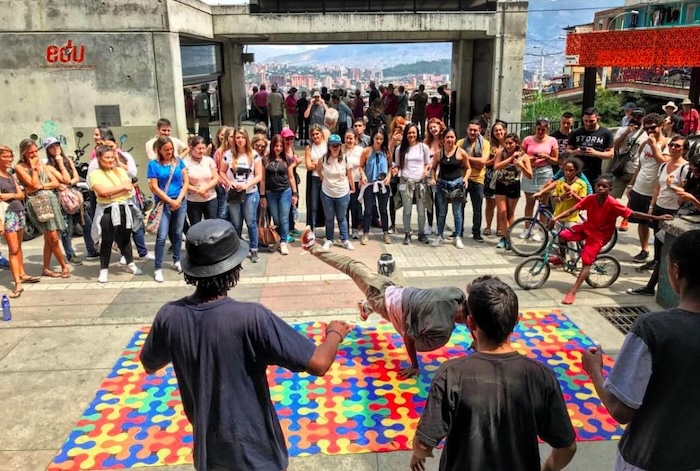
Dancers and artists in Comuna 13, Medellin
Exploitation in Comuna 13
Reports of illegal groups running the area are widely acknowledged as true. With large amounts of money coming in through tourism, local businesses, guides, and individuals are expected to pay a weekly ‘vacuna’ to the gangs for their ‘protection’.
“They only care about money. So, they don’t care if the guides are informal, if there are children working, if the businesses invade the public space. They don’t care because they charge everyone a tax. Every single business pays an illegal tax.” A social leader from the area, who wanted to remain anonymous, told El Colombiano in another report.
And Ana agrees:
“Tourism can bring a lot of money and change, and sometimes that change is positive. But sometimes the money is used in the wrong way: as a tool to control your neighbours, as a way to demonstrate your power within the community, or as a means of justifying the idea that you can do whatever you want when it comes to noise, the use of public and private spaces, setting off prohibited fireworks, etc.”
Her biggest concern is the sale and consumption of drugs in the neighbourhood.
“It is sad to see people under the influence of substances asking tourists for money. Even some of the longtime local artists sometimes appear to be struggling with substance abuse. I am not trying to criminalise drug use, but I do want to point out that there may be a worrying public health issue in this area due to it.”
An article from newspaper El Pais, offered a valuable overview of what this all means:
“This suggests a transformation of the transactions that arise between residents and the armed gangs…paying for the exposure of the territory as a space of historical memory, but not the substance: violence and extortion as a mechanism of territorial control.”
In other words, whilst there has been a shift in what runs the area, from drugs to tourism, the same fundamental social dynamics are still in place.
Remaining firm in our decision
In 2025, we did not take the decision lightly to remove visits to Comuna 13 from our itineraries.
But it soon became clear that as a ‘sustainability-focused’ tour operator, it was our responsibility to reevaluate Kagumu’s contribution.
Revisiting the neighbourhood one year later, it is clear that nothing has changed, and, if anything, the problems have only gotten worse.
We know that community-led tourism can bring huge benefits to both the local community and visitors, and the unique history of transformation and resilience in Comuna 13 remains despite the problems it now faces.
“I wish we could recognise that we already have a valuable asset: the history of this place, the murals that used to tell so many stories, and the REAL everyday lives of the people who live here, rather than the tourist trap we find today,” Ana said.
We hope that at some point Comuna 13 will find a balance between a stable tourism-led economy and a healthy, happy, and sustainable place for people to live and visit. Until then…
Kagumu’s alternative options
Kagumu has developed some excellent alternatives, including learning salsa with Union Latina and some of their incredible young dancers, eating the best Pacific Coast food at Choco Con Amor, an Afro-Colombian family-run restaurant, and getting creative in UVA de La Harmonia, an urban park in the heart of the neighbourhood of Manrique.
We also have a wide range of educational trips with a social impact that students can get involved with.
These activities offer an original experience that will introduce students to some of the incredible culture and cuisine of the region, guided by locals who live in a different neighbourhood that is not battling with tourism in the same way as Comuna 13.
One final note…
We want to make it clear that there is still a lot of great work going on in Comuna 13, led by inspiring individuals who work tirelessly to manage the influx of tourists in a positive way. And there is no problem in wanting to visit this community for yourselves.
But if you are going to go, here are a few suggestions:
- Don’t go in big groups.
- Make sure your guide is local (we highly recommend Zippy Tours).
- Be respectful! Don’t take photos of people going about their daily lives.
- Take your rubbish with you.
- Don’t give children money in exchange for anything.
- If it feels appropriate, ask people about the challenges they face. And listen to them.


