
Travel insights from Latin America
Costa Rica Study Abroad: Teaching Climate Change Through Fieldwork
Author Lydia Carey | Published on August 16, 2026
For professors or faculty teaching environmental science, sustainability, or climate change, PowerPoint slides can only do so much.
You can build a strong case study and walk students through the data, but the learning changes when they’re actually outside, in the field, conducting research, learning from scientists.
A lecture can explain how a cloud forest works, but walking underneath the misty canopy while guided by the people who protect it is something students will remember forever. Few destinations make this kind of firsthand learning as accessible as Costa Rica.
No surprise, then, that it stays near the top of the list for student sustainable study abroad destinations for teachers and faculty.
Its stunning biodiversity and commitment to conservation pair naturally with courses in environmental studies, biology, sustainability, and global development.
Here’s what a week of climate-focused fieldwork and learning looks like in practice.
Why Costa Rica Is an Ideal Study Abroad Destination for Environmental Learning
Costa Rica is widely known for two things that matter in environmental education: biodiversity and a national commitment to sustainability and ecotourism.
Despite making up only about 0.03% of the world’s landmass, the country is home to roughly 5% of the planet’s species, a level of biodiversity most students will never encounter in a campus lab.
Costa Rica offers variety and proximity. Within a few hours, students can move across volcanic terrain, into cloud forests, and out to beaches on both the Caribbean and Pacific coasts.
Along those coastlines, students can witness five of the world’s seven sea turtle species nesting, a firsthand look at conservation in motion that no textbook photo can match.
Experiential Learning in Costa Rica
Rainforest Ecosystems
Students traveling through Costa Rica with Kagumu will need to pack their hiking boots, as they head into the jungle with a naturalist guide.
Walking beneath the canopy, students see how vines climb toward light, how insects move between flowers, and how birds depend on the same trees for food and shelter.
With more than 900 bird species recorded in the region, a rainforest hike offers a live demonstration of biodiversity in action.
The Costa Rican rainforest offers an opportunity for the direct observation of one of the most biodiverse ecosystems on Earth.
Kagumu’s guides connect these observations to broader lessons on deforestation and habitat fragmentation, giving students a clear link between what they see in the field and their coursework.
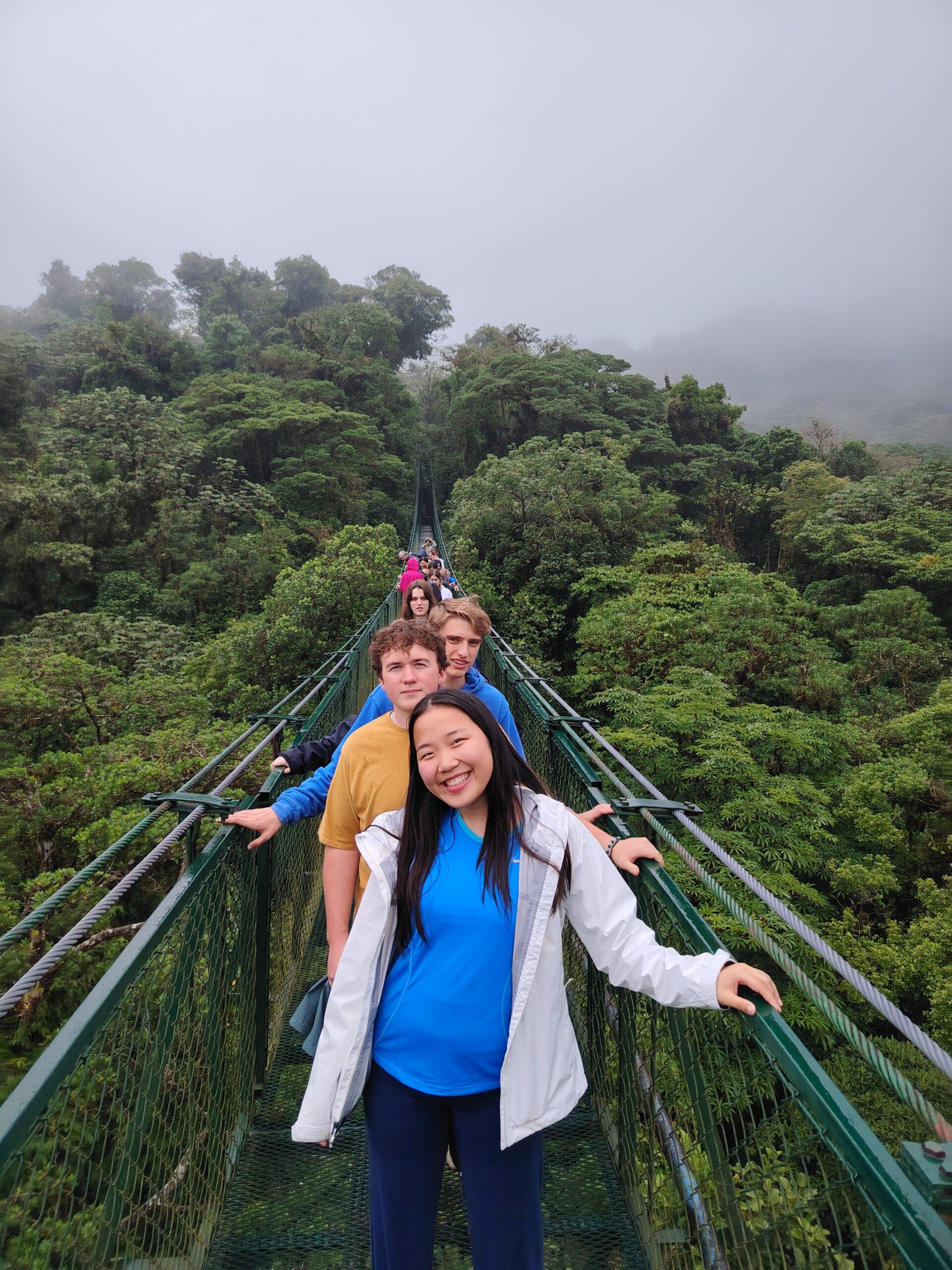
Students exploring a cloud forest in Monteverde, Costa Rica
Cloud Forest Environments
The Monteverde Cloud Forest gives students a rare ecosystem to study with an insight into carbon sequestration.
This cloud forest forms when warm tropical air rises and cools, creating a mist that blankets mountain peaks and condenses on the surrounding plant life. This unique ecosystem covers less than 0.4% of Earth’s land surface, yet it supports thousands of species.
These high-elevation forests also function as carbon sinks and headwaters for local watersheds, buffering water flow during dry months and helping supply nearby communities with renewable hydropower.
Standing beneath the canopy, it’s easier to understand why these forests matter beyond the species that live there. They store carbon, regulate water, and support nearby communities.
Conservation in Practice
Research on experiential climate education found that hands-on, solution-oriented activities paired with personal reflection build hope and engagement in students who might otherwise feel paralyzed by the scale of the climate crisis.
Field-based learning more broadly is linked to stronger student-instructor relatedness and deeper intrinsic motivation.
That’s why Kagumu’s tours include wildlife rehabilitation, reforestation work, and time for reflection throughout the trip.
Students visiting Costa Rica spend time at a local rescue center working to reintegrate monkeys, sloths, parrots, and iguanas back into the wild, then join a forestry workshop in La Fortuna working to protect the region’s sloth population.
The day ends with a soak in the hot springs at the base of Arenal volcano, built-in time to process what they’ve just witnessed before moving to the next activity.
Connecting Sustainability Education With Local Communities
True learning about sustainability is worthless without focusing on the social component.
The Maleku, the smallest Indigenous tribe in Costa Rica with only around 650 members remaining, hold a relationship to the rainforest that challenges many of the conservation frameworks taught in a Western classroom.
The forest functions as a partner in their culture, history, and survival, more than simply a resource to manage.
Kagumu’s Costa Rica itinerary is built around these kinds of connections.
On a local family’s farm near Monteverde, students take a coffee tour through the surrounding sugarcane and cacao plots, often ending with a shared plate of gallo pinto at the family’s table, then spend a morning with the Maleku directly, asking questions about their approach to land stewardship.
Reflection and Educational Outcomes
After each field visit, students gather to discuss what they saw, compare observations with their coursework, and ask questions while the experience is still fresh.
Those conversations often become the bridge between what they’ve learned in class and what they just witnessed in the field.
How Kagumu Supports Costa Rica Study Abroad Programs
Kagumu partners with faculty to design curriculum-led travel across Latin America, mapping each itinerary to your specific course objectives.
This makes it easier to petition your institution’s study abroad office for course credit. Every trip includes full liability insurance, risk assessments, and local bilingual guides at a ratio of one guide per 12 students. Programs run from 4 days to 4 weeks depending on your calendar, with planning typically starting about a year out.
If your department is weighing destinations, Kagumu also runs an environmental science program in the Galapagos, along with faculty-led options across geography, sustainability, and Spanish language study.
Reach out to Kagumu’s program director to build a custom itinerary around your syllabus.
Frequently Asked Questions
Is Costa Rica a good place to study abroad?
Costa Rica is an ideal destination for a study abroad program due to its leading focus on ecotourism, sustainability, and immense biodiversity.
Students come face to face with how conservation efforts can help in the fight against climate change as well as taking part in essential scientist-led field research.
In addition, the adventure component is covered with activities like rafting, zip lining, hiking, snorkelling, all available around this Central American country.
What are the best study abroad programs available in Costa Rica?
Study Abroad programs in Costa Rica lend perfectly to a range of academic disciplines like environmental science (or STEM), biology, sustainability, climate change, and global development.
Any curriculum that includes a focus on environmental sustainability, biodiversity, and conservation would also benefit from a program in Costa Rica.
How does Kagumu support faculty in securing institutional approval for course credit?
Kagumu collaborates directly with faculty to map every field activity, site visit, and workshop to your specific syllabus and learning objectives.
This curriculum-first approach provides the necessary academic rigor required to petition your university’s study abroad office for formal course credit approval. We can also map out specific students assignments that align perfectly with the field research, workshops and on-ground activities.
How safe is Costa Rica for study abroad students?
Costa Rica remains one of the safest countries to visit on a study abroad program in the Americas. The US government, as of August 2026, lists Costa Rica as level 2 in its travel advisory, a lot safer than its Latin American peers.
Student safety and risk management are fully integrated into every trip. Kagumu provides:
- Comprehensive Coverage: Full liability insurance and detailed risk assessments for all activities.
- On-the-Ground Support: Local, bilingual guides maintained at a maximum ratio of 1 guide per 12 students to ensure attentive group management and deep local insight.
How long do these programs run, and when should faculty start planning?
Program durations are flexible to fit your academic calendar, ranging from short-term field trips of 4 days up to 4 weeks. Because institutional approval, recruitment, and logistics require lead time, planning typically begins about one year out from your target departure date.


